Top videos

Visit http://ilectureonline.com for more math and science lectures!
In this video I will show you how to subtract vectors numerically.
Next video in this series can be seen at:
https://youtu.be/LbaT06YlJSA
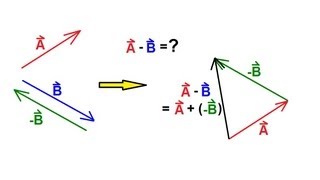
Visit http://ilectureonline.com for more math and science lectures!
In this video I will show you how to subtract vectors graphically.
Next video in this series can be seen at:
https://youtu.be/xqM1ffVmSDA

Lesson 9 (Work and Energy) of Dianna's Intro Physics Class on Physics Girl. Never taken physics before? Want to learn the basics of physics? Need an AP Physics 1 review before the exam? This course is for you!
Exercises in this video:
1. A rocket pushes a space cow, from rest, with a Force of 100N, over a distance of 10m. How much work did the rocket do? What is the final kinetic energy of the cow? How fast is the cow moving?
2. You lift a 10kg cow, with a constant velocity, 10m up. How much work did you do? How much potential energy is stored in the gravitational field?
3. You drop the cow 10m onto a big cow airbag. How fast was the cow moving right before she hit the airbag? How fast would a cow with twice as massive be moving with the same setup?
4. A giant wrecking ball with 80kg mass, is dropped from a height of 35m. It bounces off of a trampoline and reaches a height of 14m on the return trip. How much energy was lost to heat in the bounce?
5. A square cow slides down a frictionless ramp, starting at a height h above the ground. At the bottom the cow starts sliding along the ground. How far does the cow slide, in terms of m, g, h, and u, where u is the coefficient of friction between the cow and the ground? [u is mu]
Special thanks to Mark Rober for his encouraging shoutout and to Simone Giertz for letting me almost hit myself in the face with a bowling ball at her workshop.
Credits:
Dianna Cowern - Executive Producer/Host/Writer
Jeff Brock - Lead Writer/Course Designer
Laura Chernikoff - Producer
Kaitlyn Ali - Video Editor
Sophia Chen - Researcher/Writer
Erika K. Carlson - Researcher/Writer
Hope Butner - Production Assistant
Levi Butner - Videographer
Lauren Ivy - Set Design
Vanessa Hill - Consulting Producer
Aleeza McCant - Illustrator
Rachel Allen - Illustrator
Consultant - Kyle Kitzmiller
Lucy Brock, Samantha Ward - Curriculum Consultants
Cathy Cowern - Transcription
Experienced physics students always do the same thing whenever they write down an answer to a question: check the units. If the units are wrong, you know you've made a mistake! That way, you can catch your own errors and elevate your grade.
Dimensional analysis is your physics superpower: https://youtu.be/kC6U900CvwY
More physics help room videos: https://www.physicswithelliot.com/help-room-all
Tutoring inquiries: https://www.physicswithelliot.com/tutoring
If you find the content I’m creating valuable and would like to help make it possible for me to continue sharing more, please consider supporting me! You can make a recurring contribution at https://www.Patreon.com/PhysicsWithElliot, or make a one time contribution at https://www.physicswithelliot.com/support-me. Thank you so much!
About physics help room videos:
These are intro-level physics videos aimed at students taking their first physics classes. In each video, I'll teach you the fundamentals of a particular physics topic you're likely to meet in your first classes on mechanics and electromagnetism.
About me:
I’m Dr. Elliot Schneider. I love physics, and I want to help others learn (and learn to love) physics, too. Whether you’re a beginner just starting out with your physics studies, a more advanced student, or a lifelong learner, I hope you’ll find resources here that enable you to deepen your understanding of the laws of nature. For more cool physics stuff, visit me at https://www.physicswithelliot.com.

Isaac Newton's INSANE Sleep Habits 😬
#isaacnewton #bizaare #strange #interestingfacts
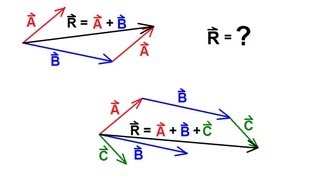
Visit http://ilectureonline.com for more math and science lectures!
In this video I will show you how to add vectors graphically using the tip-to-toe method.
Next video in this series can be seen at:
https://youtu.be/WsV3Qx8KP08

Visit http://ilectureonline.com for more math and science lectures!
In this video I will show you how to calculate the final velocity of a car moving at constant acceleration.
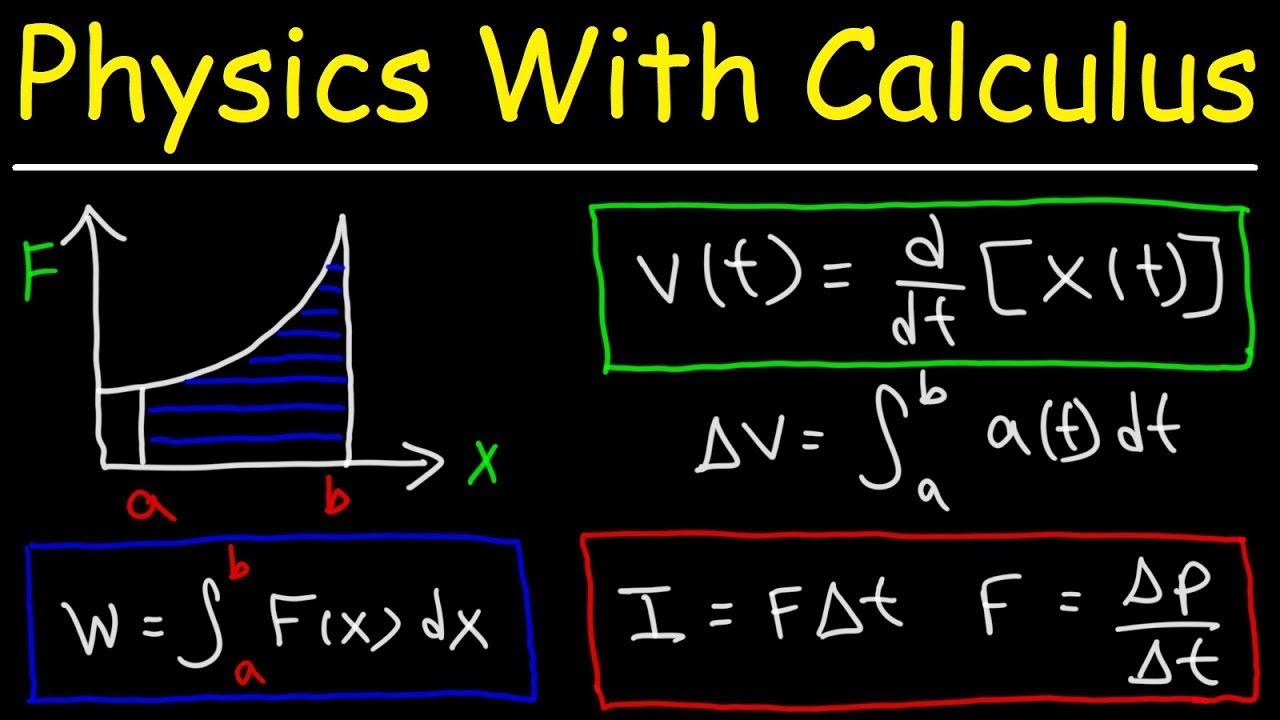
This video tutorial provides a basic introduction into physics with calculus. It covers derivatives such as the power rule and basic integration of definite integrals and indefinite integrals. This video covers topics on displacement, velocity, acceleration, net force, work, momentum, and impulse.
Full 56 Minute Video on Patreon:
https://www.patreon.com/MathScienceTutor
Direct Link to The Full Video:
https://bit.ly/3WO6m6Q
Printable PDF Worksheet:
https://bit.ly/3jSId0x
Physics PDF Worksheets:
https://www.video-tutor.net/ph....ysics-basic-introduc
________________________________
Join The Membership Program:
https://bit.ly/46xaQTR
Full Video on YouTube:
https://www.youtube.com/watch?v=l7cN9ZvKMMA

In this tutorial Fahad Sir discussed about various development of physical Science !
Stay connected with our Facebook page and Facebook group
1. https://www.facebook.com/amaderschoolofficial/ (ফেসবুক পেইজ )
2. https://www.facebook.com/groups/ovinob/ (ফেসবুক গ্রুপ)
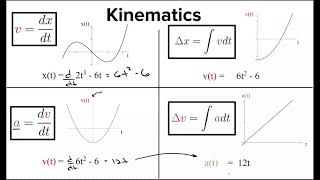
This is a review of all the topics on the AP Physics C Mechanics exam.

Professor Brian Cox of the University of Manchester presents an educational walk, through the fundamentals of Particle Physics.
Disclaimer: The copyright owner provides this content for educational purposes.

ALL OF PHYSICS in 14 Minutes: https://youtu.be/ZAqIoDhornk
Everything is made of atoms. Chemistry is the study of how they interact, and is known to be confusing, difficult, complicated...let's learn General Chemistry in under 20 Minutes.
This is not ALL of Chemistry, as fields like "Organic Chemistry" deserve videos of their own. But, this is the foundation, or "General Chemistry", which contains most concepts you need to know to understand other topics and fields of Chemistry.
This is a summary and revision of around 4 years of Chemistry you learn in school, with maybe some university level concepts sprinkled in the mix.
This video is a good summary for preparing for exams and finals. Maybe. Perhaps.
Now go learn all of Chemistry. And share this with your friends who suck at Chemistry
Timestamps:
00:00 Intro
00:16 Valence Electrons
00:34 Periodic Table
01:24 Isotopes
01:34 Ions
01:47 How to read the Periodic Table
02:09 Molecules & Compounds
02:27 Molecular Formula & Isomers
02:53 Lewis-Dot-Structures
03:03 Why atoms bond
03:26 Covalent Bonds
03:37 Electronegativity
03:54 Ionic Bonds & Salts
04:25 Metallic Bonds
04:59 Polarity
05:37 Intermolecular Forces
05:51 Hydrogen Bonds
06:00 Van der Waals Forces
06:20 Solubility
06:46 Surfactants
07:00 Forces ranked by Strength
07:07 States of Matter
07:28 Temperature & Entropy
07:49 Melting Points
08:01 Plasma & Emission Spectrum
08:35 Mixtures
09:24 Types of Chemical Reactions
09:45 Stoichiometry & Balancing Equations
10:16 The Mole
10:46 Physical vs Chemical Change
11:05 Activation Energy & Catalysts
11:24 Reaction Energy & Enthalpy
11:42 Gibbs Free Energy
12:50 Chemical Equilibriums
13:15 Acid-Base Chemistry
13:41 Acidity, Basicity, pH & pOH
14:43 Neutralisation Reactions
14:56 Redox Reactions
15:18 Oxidation Numbers
16:01 Quantum Chemistry
Music by Audionautix.com

Lesson 14 (Rotation and Torque) of Dianna's Intro Physics Class on Physics Girl. Never taken physics before? Want to learn the basics of physics? Need an AP Physics 1 review before the exam? This course is for you!
Exercises in this video:
1. If you are standing on Earth’s equator (radius about 6380km), how fast are you going? What is your rotational velocity? What is your angular velocity?
2. A tiny cat, mass 0.50kg is clinging to the edge of a record spinning at 45rpm. If the radius of the record is 0.10m, what is the frictional force keeping that cat moving in a circle?
3. If Dianna, mass 60 kg, is standing on a scale on the equator, what does the scale actually read?
4. Dianna and Marie want to balance on a seesaw. But Marie has 3 times Dianna’s mass. How far away from Dianna should they move the fulcrum in order to balance the seesaw?
Special thanks to propulsion engineer Diana Alsindy for her awesome shoutout at the end of the video! You can follow her on Twitter @DianaAlsindy
Credits:
Dianna Cowern - Executive Producer/Host/Writer
Jeff Brock - Lead Writer/Course Designer
Laura Chernikoff - Producer
Rachel Watson - Video Editor
Sophia Chen - Researcher/Writer
Erika K. Carlson - Researcher/Writer
Hope Butner - Production Assistant
Levi Butner - Videographer
Lauren Ivy - Set Design
Vanessa Hill - Consulting Producer
Aleeza McCant - Illustrator
Rachel Allen - Illustrator
Consultant - Kyle Kitzmiller
Lucy Brock, Samantha Ward - Curriculum Consultants
Cathy Cowern - Transcription

AP Physics 1 - 2020 Exam Sample Questions Full Solution
Link To Question
https://apcentral.collegeboard.....org/pdf/ap-2020exam
Check out my personal finance channel with over 10k subs https://www.youtube.com/channe....l/UCVo7LwuxomC4k5yHE
Consider Showing Some Love On Venmo @TheFinnMindset
A small sphere of mass M is suspended by a string of length L. The sphere is made to move in a horizontal circle of radius R at a constant speed, as shown above. The center of the circle is labeled point C, and the string makes angle θ0 with the vertical
Two students are discussing the motion of the sphere and make the following statements.
Student 1: None of the forces exerted on the sphere are in the direction of point C, the center of the circular path. Therefore, I don’t see how there can be a centripetal force exerted on the sphere to make it move in a circle.
Student 2: I see another problem. The tension force exerted by the string is at an angle from the vertical. Therefore, its vertical component must be less than the weight Mg of the sphere. That means the net force on the sphere has a downward vertical component, and the sphere should move downward as well as moving around in a circle.
(a) What is one aspect of Student 1’s reasoning that is incorrect? Explain why.
(b) What is one aspect of Student 2’s reasoning that is incorrect? Explain why.
Student 3 correctly derives two equations to relate the tension force FT to the net force Fnet and the other quantities.
(c) Explain how one of the equations can be used to challenge Student 1’s claim.
(d) Explain how one of the equations can be used to challenge Student 2’s claim.
The students observe that the radius R increases as the speed v of the sphere increases. Together, they derive the equation R = v L/g to calculate the radius of the circle R followed by the sphere if its speed is v.
(e) Regardless of whether this equation is correct or incorrect, does it plausibly model the students’ observation about the relationship between R and v? Why or why not?
(f) This equation does not correctly model the relationship between R and v if v is very fast. Explain why.
Instead of moving in a horizontal circle, the sphere now moves in a vertical plane so that it is a simple pendulum, as shown above. The maximum angle θmax that the string makes from the vertical can be assumed to be small. The graph below shows data for the square of the pendulum period T as a function of string length L.
Explain how the above graph would change under each of the following circumstances. Justify your answers.
(g) The mass of the sphere is increased.
(h) The maximum angle θmax is decreased.
(i) The pendulum is taken to the Moon.
If there is a topic you want me to do leave them in the comments below.
#physicstutor #mathtutor

Lesson 15 (Angular Momentum) of Dianna's Intro Physics Class on Physics Girl. Never taken physics before? Want to learn the basics of physics? Need a review of AP Physics concepts before the exam? This course is for you!
More fun exploration of water spinning angular momentum demo from Steve Mould and Smarter Every Day: https://www.youtube.com/watch?v=M4-L8UgPkOk
Exercises in this video:
1. A box and a sphere are sliding and rolling, respectively, down a ramp. If they start from the same height, and we ignore friction on the box, which will reach the ground first?
What if it were a full soda can and an empty soda can?
2. A sphere of mass 4kg rolls down a ramp, starting with a height of 5 meters from the ground. How fast is the sphere rolling when it gets to the ground?
3. If every person on Earth ran around the equator in the same direction, what would their total angular momentum be? Use 65 kg as the average mass of the 7.8 billion people on Earth, and let them run at 5m/s.
4. Given 8 x 10³⁷ kg•m² as the Moment of Inertia of Earth, by how much would all those people running change the angular speed of the Earth?
Special thanks to Kari Byron for her wonderful shoutout at the end of the video! You can follow her on Twitter @KariByron and Instagram @therealkaribyron.
Credits:
Dianna Cowern - Executive Producer/Host/Writer
Jeff Brock - Lead Writer/Course Designer
Laura Chernikoff - Producer
Kaitlyn Today - Video Editor
Sophia Chen - Researcher/Writer
Erika K. Carlson - Researcher/Writer
Hope Butner - Production Assistant
Levi Butner - Videographer
Lauren Ivy - Set Design
Vanessa Hill - Consulting Producer
Aleeza McCant - Illustrator
Rachel Allen - Illustrator
Consultant - Kyle Kitzmiller
Lucy Brock, Samantha Ward - Curriculum Consultants
Cathy Cowern - Transcription

เอกสารประกอบการเรียน
https://bit.ly/3LZ8x1h
----------------------------------------------------------------------
website
https://sigmaking.com/
https://sigmakingonline.com/
Facebook : SigmaKing
https://www.facebook.com/sigmaking/

Courses on Khan Academy are always 100% free. Start practicing—and saving your progress—now: https://www.khanacademy.org/sc....ience/high-school-ph
Using position-time graphs and number lines to find displacement and distance traveled.
View more lessons or practice this subject at http://www.khanacademy.org/science/ap-physics-1/ap-one-dimensional-motion/distance-displacement-and-coordinate-systems/v/position-time-graphs?utm_source=youtube&utm_medium=desc&utm_campaign=apphysics1
AP Physics 1 on Khan Academy: Meet one of our writers for AP¨_ Physics, Sean. A physics teacher for seven years, Sean has taught AP¨_ Physics 1, AP¨_ Physics C, and Conceptual Physics. HeÕs also a former mechanical engineer. Sean is based in Boise, Idaho, and is a Khan Academy physics fellow, creating awesome new exercises and articles for AP¨_ Physics.
Khan Academy is a nonprofit organization with the mission of providing a free, world-class education for anyone, anywhere. We offer quizzes, questions, instructional videos, and articles on a range of academic subjects, including math, biology, chemistry, physics, history, economics, finance, grammar, preschool learning, and more. We provide teachers with tools and data so they can help their students develop the skills, habits, and mindsets for success in school and beyond. Khan Academy has been translated into dozens of languages, and 15 million people around the globe learn on Khan Academy every month. As a 501(c)(3) nonprofit organization, we would love your help! Donate or volunteer today!
Donate here: https://www.khanacademy.org/donate?utm_source=youtube&utm_medium=desc
Volunteer here: https://www.khanacademy.org/contribute?utm_source=youtube&utm_medium=desc

Sal solves a word problem to find average velocity and speed of an object in one-dimension.
View more lessons or practice this subject at https://www.khanacademy.org/science/ap-physics-1/ap-one-dimensional-motion/average-velocity-and-speed/v/average-velocity-and-speed-worked-example?utm_source=youtube&utm_medium=desc&utm_campaign=apphysics1
AP Physics 1 on Khan Academy: Meet one of our writers for AP¨_ Physics, Sean. A physics teacher for seven years, Sean has taught AP¨_ Physics 1, AP¨_ Physics C, and Conceptual Physics. HeÕs also a former mechanical engineer. Sean is based in Boise, Idaho, and is a Khan Academy physics fellow, creating awesome new exercises and articles for AP¨_ Physics.
Khan Academy is a nonprofit organization with the mission of providing a free, world-class education for anyone, anywhere. We offer quizzes, questions, instructional videos, and articles on a range of academic subjects, including math, biology, chemistry, physics, history, economics, finance, grammar, preschool learning, and more. We provide teachers with tools and data so they can help their students develop the skills, habits, and mindsets for success in school and beyond. Khan Academy has been translated into dozens of languages, and 15 million people around the globe learn on Khan Academy every month. As a 501(c)(3) nonprofit organization, we would love your help! Donate or volunteer today!
Donate here: https://www.khanacademy.org/donate?utm_source=youtube&utm_medium=desc
Volunteer here: https://www.khanacademy.org/contribute?utm_source=youtube&utm_medium=desc
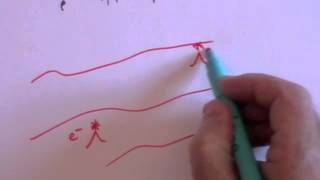
Part 1 of a series: covering introduction to Quantum Field Theory, creation and annihilation operators, fields and particles.
Courses on Khan Academy are always 100% free. Start practicing—and saving your progress—now: https://www.khanacademy.org/sc....ience/high-school-ph
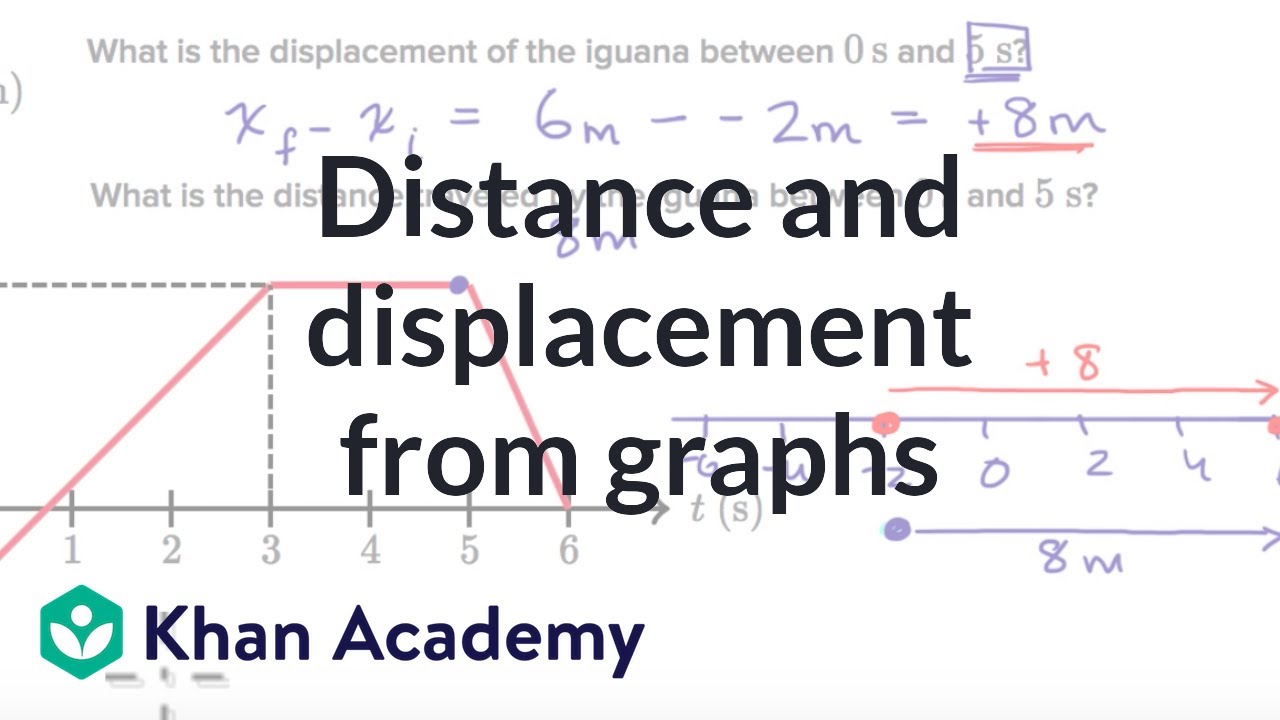
Worked examples finding displacement and distance from position-time graphs.
View more lessons or practice this subject at http://www.khanacademy.org/science/ap-physics-1/ap-one-dimensional-motion/distance-displacement-and-coordinate-systems/v/examples-interpreting-position-time-graphs?utm_source=youtube&utm_medium=desc&utm_campaign=apphysics1
AP Physics 1 on Khan Academy: Meet one of our writers for AP¨_ Physics, Sean. A physics teacher for seven years, Sean has taught AP¨_ Physics 1, AP¨_ Physics C, and Conceptual Physics. HeÕs also a former mechanical engineer. Sean is based in Boise, Idaho, and is a Khan Academy physics fellow, creating awesome new exercises and articles for AP¨_ Physics.
Khan Academy is a nonprofit organization with the mission of providing a free, world-class education for anyone, anywhere. We offer quizzes, questions, instructional videos, and articles on a range of academic subjects, including math, biology, chemistry, physics, history, economics, finance, grammar, preschool learning, and more. We provide teachers with tools and data so they can help their students develop the skills, habits, and mindsets for success in school and beyond. Khan Academy has been translated into dozens of languages, and 15 million people around the globe learn on Khan Academy every month. As a 501(c)(3) nonprofit organization, we would love your help! Donate or volunteer today!
Donate here: https://www.khanacademy.org/donate?utm_source=youtube&utm_medium=desc
Volunteer here: https://www.khanacademy.org/contribute?utm_source=youtube&utm_medium=desc

This video is a review of circular motion and gravitation for AP Physics 1.

Lesson 12 (Conservation of Momentum) of Dianna's Intro Physics Class on Physics Girl. Never taken physics before? Want to learn the basics of physics? Need an AP Physics 1 review before the exam? This course is for you!
Exercises in this video:
1. Compare the momenta of two objects: one with a mass of 260kg moving at 20m/s, and the other with a mass of 1950kg moving at 1m/s.
2. What are two different (common) ways to represent the units of momentum?
3. You and your spherical space cow push off of each other, in space. The cow, which has a mass of 100kg, ends up with a speed of 2.5m/s. Your mass is 50kg. What will your velocity be after the push?
4. What is the total impulse of a rocket that thrusts with a force of 7600kN for 162 seconds?
Special thanks to Cheyenne Polius for her awesome shoutout at the end of the video!
And thank you to the Planetary Society for allowing us to use the footage for their awesome light sail.
Credits:
Dianna Cowern - Executive Producer/Host/Writer
Jeff Brock - Lead Writer/Course Designer
Laura Chernikoff - Producer
Rachel Watson - Video Editor
Sophia Chen - Researcher/Writer
Erika K. Carlson - Researcher/Writer
Hope Butner - Production Assistant
Levi Butner - Videographer
Lauren Ivy - Set Design
Vanessa Hill - Consulting Producer
Aleeza McCant - Illustrator
Rachel Allen - Illustrator
Consultant - Kyle Kitzmiller
Lucy Brock, Samantha Ward - Curriculum Consultants
Cathy Cowern - Transcription

In this chapter of class 11 Physics - Physical world we learn about Scientific Method | Fundamental Forces | Gravitational force | Electromagnetic force | Nuclear force | Derived forces | Physical World Revision video.
Crash Course Class 11 Physical World| Physical World Complete Chapter in 1 video | Class 11 Physics
visit www.HomeSchoolChannels.com for more videos